
How to Operate on Binance and Its Partner Exchanges: A Practical Trading Guide

In the fast-evolving world of cryptocurrency trading, Binance remains one of the most influential centralized exchanges globally. However, the concept of a "Binance joint exchange" or "Binance partner exchange" has gained traction among traders seeking liquidity, reduced fees, or access to specific regional markets. Understanding how to operate on these platforms is essential for both beginners and experienced investors.
First, it is important to clarify what a "Binance joint exchange" typically refers to. This can mean Binance's own sub-platforms like Binance.US, Binance Futures, or Binance DEX, as well as affiliated exchanges that use Binance's liquidity or technology through the Binance Cloud program. These partner exchanges often share similar interfaces and trading pairs but may have different regulatory frameworks, deposit methods, or token listings.
To begin operating on any Binance-related exchange, the first step is account creation. You will need to provide a valid email address, set up two-factor authentication (2FA), and complete KYC verification. For Binance joint exchanges that serve specific regions, such as Binance.US, you may need to provide a government-issued ID and proof of residence. This process is mandatory for enabling higher withdrawal limits and full trading access.
Once your account is verified, the next step is funding your wallet. Most Binance-linked exchanges support a variety of deposit methods, including bank transfers, credit cards, and crypto deposits. For joint exchanges using the Binance Cloud infrastructure, you may also find support for local payment methods like P2P trading or mobile money. Always check the minimum deposit amount and network fees before transferring funds.
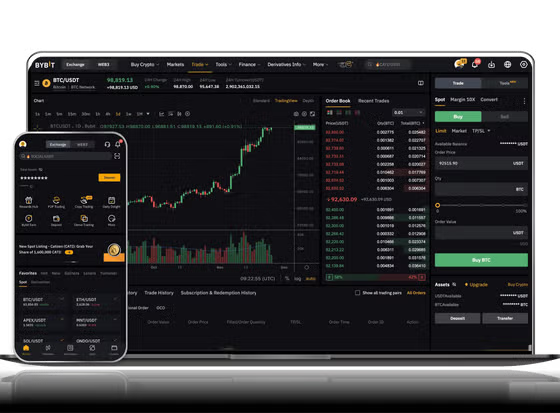
With funds in your account, you can proceed to the trading interface. Binance and its partner exchanges typically offer two main trading modes: "Basic" for spot trading and "Advanced" for limit and stop-limit orders. If you are using a joint exchange that mirrors Binance's order book, you will see similar depth charts, order books, and trading pairs. To execute a trade, select a trading pair (e.g., BTC/USDT), choose the order type, enter the amount, and confirm the transaction. Market orders execute instantly at the current price, while limit orders allow you to set a target price.
For users looking to maximize efficiency, many Binance partner exchanges also offer margin trading, futures, and staking services. However, these products carry higher risk. Before using leverage or derivatives, make sure you understand the liquidation price, funding rate, and margin requirements. Some joint exchanges may have different leverage limits or contract specifications compared to the main Binance platform.
Security is another critical aspect of operating on any Binance joint exchange. Always enable withdrawal whitelists, device management, and anti-phishing codes. Be cautious of fake websites or clone domains that mimic Binance's interface. Only use the official URLs provided by Binance or its verified partners. If the exchange supports API trading, restrict API permissions to "enable reading" only unless you are using automated trading bots.
Finally, if you encounter issues such as deposit delays or verification problems, most joint exchanges have their own customer support teams. However, some partner exchanges use Binance's support ticketing system. In either case, keep transaction IDs and screenshots ready for faster resolution.
In summary, operating on a Binance joint exchange involves account registration, verification, funding, trading, and security management. While the user experience is largely similar to the main Binance platform, always research the specific withdrawal limits, supported countries, and regulatory status of the joint exchange you choose. By following these procedural steps and maintaining strong security practices, you can safely and effectively trade on these interconnected platforms.


发表评论