
USDC Trading Guide: How to Buy, Sell, and Swap USD Coin on Top Exchanges

USDC, or USD Coin, is one of the most popular stablecoins in the cryptocurrency market. It is pegged 1:1 to the US dollar, meaning each USDC is backed by one dollar held in reserve. This stability makes it a fundamental tool for traders, investors, and anyone looking to move value without the volatility of Bitcoin or Ethereum. If you want to learn how to trade USDC, this guide will walk you through the key methods, platforms, and strategies.
First, understand that trading USDC typically does not involve betting on price changes, since its value stays close to $1. Instead, trading USDC usually refers to using it as a base currency to buy other cryptocurrencies, or converting other coins into USDC to lock in profits or avoid market dips. You can also trade USDC for fiat currency like USD, or earn interest by lending it on decentralized finance (DeFi) platforms.
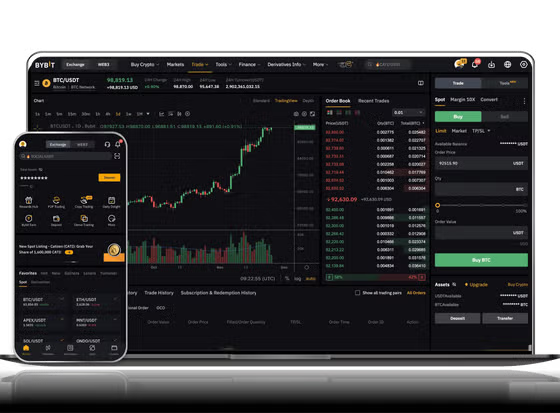
The most common way to trade USDC is through a centralized exchange such as Coinbase, Binance, Kraken, or Gemini. These platforms allow you to deposit US dollars or other cryptocurrencies, then swap them for USDC. For example, on Coinbase, you can simply click "Buy" and select USDC. On Binance, you can use the spot trading pair like BTC/USDC or ETH/USDC. These trades are fast, with low fees, and the liquidity is high, meaning you can execute large orders without much slippage.
Decentralized exchanges (DEXs) offer another way to trade USDC. Platforms like Uniswap, SushiSwap, and Curve Finance allow you to swap tokens directly from your wallet without a middleman. You would connect a wallet like MetaMask, choose the token you want to trade (e.g., ETH for USDC), and confirm the transaction. DEXs are ideal for traders who want privacy and control, but you need to pay attention to gas fees, especially on the Ethereum network. Using Layer 2 solutions like Arbitrum or Polygon can reduce costs.
If you are trading USDC for profit, consider strategies like arbitrage. Because USDC should always be worth $1, any price deviation on different exchanges creates an opportunity. For example, if USDC is trading at $0.99 on one DEX and $1.01 on another, you can buy low and sell high. However, this requires speed, low fees, and often automated bots. Another strategy is yield farming: you can provide USDC to liquidity pools on platforms like Aave or Compound and earn interest. This is not speculative trading, but it is a way to generate returns from your USDC holdings.
Always verify the USDC contract address before trading. USDC exists on multiple blockchains: Ethereum (ERC-20), Solana, Algorand, Stellar, and more. Sending USDC to the wrong network can result in permanent loss. For example, ERC-20 USDC cannot be sent to a Solana address without a bridge. Use cross-chain bridges like Wormhole or Multichain if you need to move USDC between networks, but be aware of bridge risks.
Security is crucial. Enable two-factor authentication on centralized exchanges, use hardware wallets for long-term storage, and never share your private keys. If you are trading large volumes, check the liquidity depth and spread on the order book. For most users, the simplest and safest method is to buy USDC on a trusted centralized exchange, then transfer it to a DeFi platform if needed.
In summary, trading USDC is straightforward: buy it on exchanges to use as a stable asset, swap it for other tokens, or deploy it in DeFi for yield. Whether you are a beginner looking for a safe haven or an advanced trader seeking arbitrage, USDC provides a reliable foundation. Always stay informed about network fees, platform risks, and market conditions. With the right approach, USDC can be a powerful tool in your crypto trading toolkit.


发表评论