
Step-by-Step Guide to Operating Binance Exchange: Complete Beginners Walkthrough

Binance is widely recognized as the worlds largest cryptocurrency exchange by trading volume. For newcomers, understanding how to operate the Binance platform can seem complex, but breaking it down into logical steps makes the process straightforward. This guide provides a clear, step-by-step explanation of the essential operations on Binance, from account creation to advanced trading features.
Step 1: Account Registration and Security Setup
To begin, visit the official Binance website (binance.com) or download the Binance mobile app. Click on "Register" and provide your email address or phone number. After entering a strong password, you will receive a verification code. Once verified, the most critical step is enabling Two-Factor Authentication (2FA). Use the Google Authenticator app or Binances own authenticator to secure your account. Never skip this step, as 2FA is your primary defense against unauthorized access.
Step 2: Identity Verification (KYC)
Although you can deposit and withdraw limited amounts without verification, full operation requires Identity Verification (KYC). Navigate to the "Profile" icon and select "Identification." Upload a clear photo of your government-issued ID (passport or drivers license) and complete the facial recognition scan. Verification usually takes a few minutes to a few hours. Completing KYC increases your withdrawal limits and unlocks all platform features.
Step 3: Funding Your Binance Account
Binance offers multiple deposit methods. The most common is depositing fiat currency (USD, EUR, etc.) via bank transfer or credit/debit card. Alternatively, you can deposit cryptocurrency from another wallet. To do this, go to "Wallet" > "Deposit," select the cryptocurrency (e.g., Bitcoin or USDT), and copy your unique deposit address. Send your funds to this address. Always double-check the network (e.g., BEP-20, ERC-20) to avoid losing funds.
Step 4: Navigating the Spot Trading Interface
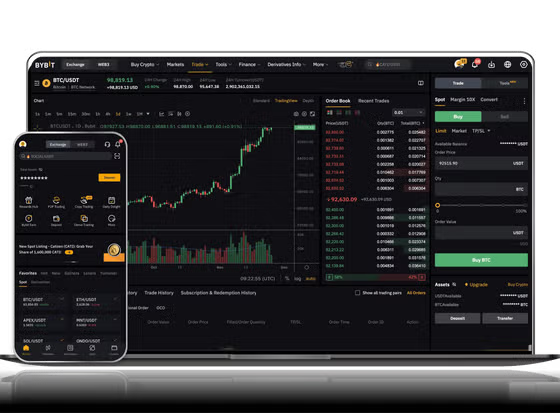
Spot trading is the core operation on Binance. Click on "Trade" > "Classic" or "Advanced." The interface has four main sections: the "Trading Pair" list (e.g., BTC/USDT), the "Order Book" showing buy and sell orders, the "Chart" for price analysis, and the "Order Entry" panel. Start by searching for your desired trading pair in the top-left corner.
Step 5: Placing Your First Buy or Sell Order
There are three primary order types on Binance: Market, Limit, and Stop-Limit.
- Market Order: Buy or sell instantly at the current market price. Enter the amount of the base currency (e.g., 100 USDT) and click "Buy BTC." The order fills immediately.
- Limit Order: Set a specific price at which you want to trade. For example, if Bitcoin is trading at $60,000, you can set a limit buy at $59,000. Your order will only execute if the price drops to that level.
- Stop-Limit Order: A conditional order that triggers when the price hits a "stop" price, then places a limit order. This is useful for managing risk.
Step 6: Advanced Features: Futures, Staking, and Earn
Beyond spot trading, Binance offers advanced operations. Binance Futures allows margin trading with leverage (e.g., 5x or 10x), but carries high risk. Beginners should start with a small test position. Binance Staking lets you lock up coins like Ethereum or BNB to earn passive interest. Navigate to "Earn" to explore Flexible Savings, Locked Staking, or Launchpool for earning new tokens. P2P Trading is another option, allowing direct trades between users using local payment methods.
Step 7: Withdrawing Funds to Your External Wallet
When you want to move your funds off the exchange, go to "Wallet" > "Withdraw." Select the cryptocurrency, enter the wallet address, and choose the correct network (e.g., BEP-20 for low fees). Confirm the transaction with your 2FA code. Note that Binance may charge a small withdrawal fee, which varies by cryptocurrency.
Key Safety Tips for Binance Users
Always enable 2FA and whitelist withdrawal addresses for added security. Avoid clicking on unknown links claiming to be from Binance. Check the official "Binance Verify" page to authenticate Binance employees. Never share your private keys or seed phrase with anyone. For storing large amounts, consider transferring your assets to a hardware wallet like Ledger or Trezor.
Understanding Common Errors and How to Solve Them
New users often encounter errors like "Insufficient Balance" (check your available balance in the trading pair) or "Order Failed - Minimum Notional" (your order value must meet a minimum threshold, often 10 USDT). If your withdrawal is pending, ensure your 2FA code is correct and that you havent exceeded daily limits. For persistent issues, Binances 24/7 customer support is available via live chat on the website.
Conclusion: Start Small and Learn
Operating Binance becomes intuitive with practice. Begin with small amounts to familiarize yourself with the interface. Use the platforms integrated learning hub, "Binance Academy," for free educational content. Remember that all trading involves risk, especially derivatives and leveraged products. By following this step-by-step guide, you can confidently manage deposits, trades, and withdrawals on Binance while maintaining a strong security posture.


发表评论