
Why You Need to Know Withdrawal Rules on Binance, OKX, and Bybit in 2025
When crypto traders search for "Binance withdrawal" or "top 3 exchange cashout methods," they are usually at a critical point: securing their profits or moving funds to a safer environment. Understanding how to withdraw from Binance, OKX, and Bybit—the world's three largest exchanges by trading volume—is not just a technical step; it is a core risk management skill. Each platform has distinct fee structures, network options, and security protocols that directly affect your final take-home amount.
Let us first examine the standard process on Binance. As the industry giant, Binance offers the most extensive range of withdrawal networks. To cash out from Binance, you must first navigate to the "Wallet" section and select "Withdraw." The critical decision here is choosing the correct network—for example, using ERC-20 for USDT will cost you a fixed fee of approximately 1 USDT, while using BEP-20 (Binance Smart Chain) cuts that fee to around 0.2 USDT. Always confirm that your destination wallet supports the same network, or you face total loss. One common mistake traders make is selecting the cheapest network without checking recipient compatibility. For large sums, using TRC-20 (Tron) for USDT is often the most cost-effective and fast, with a fee near 1 USDT and near-instant settlement.
For OKX, the withdrawal interface emphasizes speed and multi-chain support. OKX supports over 60 blockchains, and its dynamic fee model adjusts based on network congestion. When withdrawing from OKX, you will notice a "Slow," "Normal," and "Rapid" speed option. Selecting "Normal" usually processes within 5-10 minutes with a moderate fee. For example, withdrawing ETH via ERC-20 on OKX might cost 0.004 ETH, while the same transaction on Arbitrum costs only 0.0002 ETH. This flexibility makes OKX a favorite among traders who prioritize low fees over immediate speed. However, one safety feature unique to OKX is its mandatory address whitelist—you must add and confirm a new withdrawal address 24 hours in advance, which prevents unauthorized access but requires advanced planning.
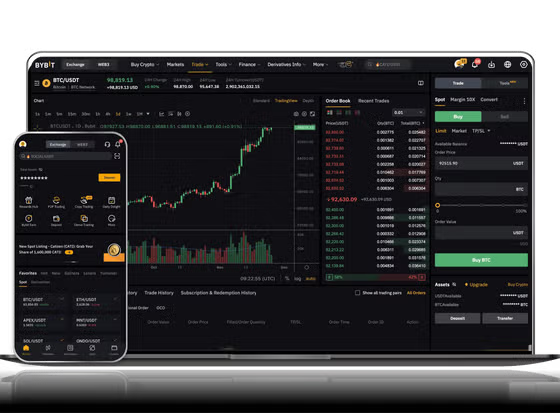
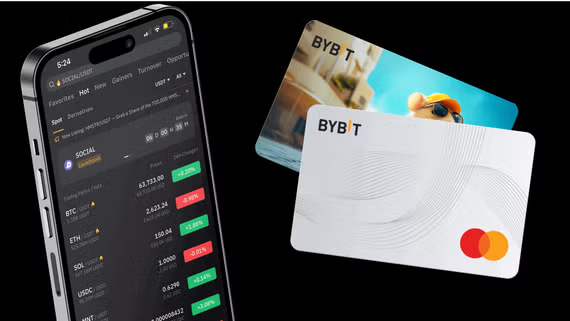
Bybit, primarily known for derivatives trading, has a surprisingly streamlined spot withdrawal system. Bybit withdrawal fees are generally lower than Binance for Bitcoin—0.00035 BTC compared to Binance's 0.0004 BTC. The platform uses a "Verified Address" system similar to OKX, but with a shorter activation period of 4 hours. For traders cashing out large volumes, Bybit also offers an internal transfer to other Bybit users at zero fee. This feature is crucial for OTC (over-the-counter) deals: you can send funds to a trusted buyer's Bybit wallet instantly, and the buyer then sends fiat to your bank account. This bypasses blockchain fees entirely.
Now, combining these insights for practical strategy: For immediate cashout, use Binance BEP-20 for USDT if your wallet supports it. For long-term fee savings, switch to OKX and choose Polygon or Arbitrum networks. For OTC large amounts, utilize Bybit's internal transfer. Always double-check the withdrawal address character by character—a single letter error is irreversible. Another pro tip is to withdraw a small test amount first before moving your entire balance. This "0.1% rule" has saved many traders from expensive mistakes.
The security landscape is also evolving. In 2025, major exchanges now require mandatory withdrawal confirmation via email and Google Authenticator. Some even add biometric verification for high-value withdrawals. Never disable these features. If a third-party service promises to "speed up your withdrawal" for a fee, it is almost certainly a scam. Official exchanges never ask for your private keys or funds to "process withdrawal."
In summary, the three exchanges handle withdrawal differently: Binance offers the widest network choice, OKX gives you fee-speed flexibility, and Bybit excels in low-cost internal transfers. Your optimal withdrawal method depends on your coin type, amount, and destination wallet. Understand each platform's specific fee structure and security features before clicking "submit." With this knowledge, you can minimize costs and maximize safety every time you cash out.


发表评论